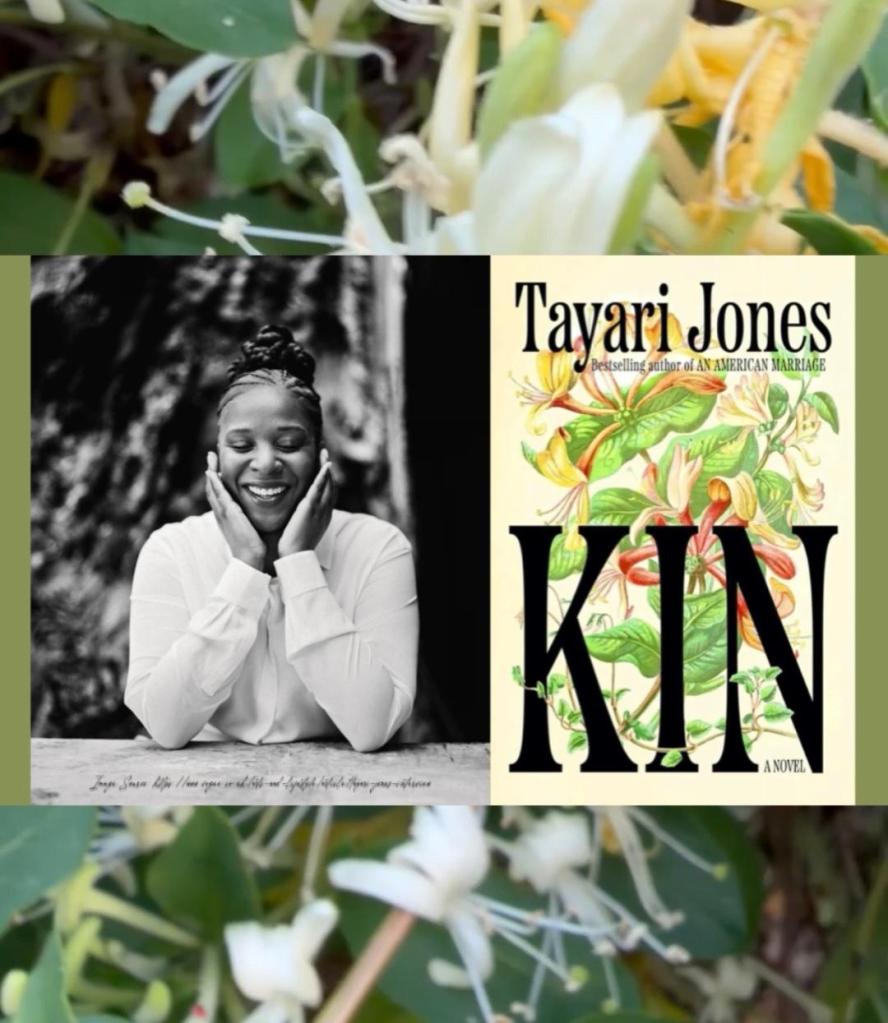
Rock-A-Bye Baby What the heck happened? It is both a simple and a complex question to ask. The inquiry implies something expected, tangible even…and being met with the opposite. It is this question that stood out to me when me and my daughter ventured to Atlanta just days prior to the official release of “Kin” and watched and listened to Pearl Cleage converse with the Georgia-born author. What does happen in the lives of black women? Especially lives that are centered very much within and amongst black womanhood? Jones writes boldly yet with an innocent authenticity from this perspective, and she does it well. While explaining her process and the overall feel of the novel, Jones stated, “well, most of our mothers are not publishing their diaries.” Thus, we simply yet complexly don’t know what went on in their lives. We know the obvious outcomes; but the details leading up to said outcomes are oftentimes a mystery filled in by our own vulnerable or guarded imaginations. It is within this muted and muffled (often void) space that the answers lie. Jones takes us on a journey beginning in 1950’s Honeysuckle, Louisiana with two cradle friends at the helm – Annie and Vernice. Through their movements out of Honeysuckle towards Memphis and Atlanta, that muffled voice gains volume (and clarity) and we are able to experience just what the heck happened.
On The Tree Top Both Annie and Vernice grow up without their mothers. Annie’s mother is presumably a bit of a recluse and runs off shortly following Annie’s birth. Vernice’s mother is killed by her husband before Vernice is able to talk. Both girls suffer great loss before knowing what loss is. However, Jones relays this innate knowing both inside and outside of supposed natural development. They are somewhat opposites who trauma bond (for lack of a better term) but in a unique way, and are offered a sort of aerial view not afforded by others whose mothers’ presence grounds and centers. They learn very early on that mothers are held accountable for things quite obviously out of their control. Though there is power here (in motherhood) there is also great risk of harm. The things said to these girls about their mothers go with them throughout life and form a framework that is a prison one day, and a high speed chase the next.
When The Wind Blows This story is one that highlights very female-centered upbringings as it is Vernice’s maternal aunt who steps in to raise her following Arletha’s death. And it is Annie’s maternal grandmother who takes on the responsibility of rearing her following Hattie Mae’s departure. Jones highlights this strong emphasis of female leadership, flow, and centering within the first line of the novel as Vernice states, “My first word was ‘mother’, spoken out loud and with texture. MOTHER.” While reading, I remember desiring brothers for these two main characters – male figures who saw and experienced them outside of direct provision, sexuality and procreation; male figures who would also allow the girls a perspective of masculinity outside of the endurance of duty and harm. Both Vernice and Annie seem to be in an intense search throughout the novel. But, what are they searching for? Some might say that Annie is obviously in pursuance of a tangible encounter as her mother is still living. And some might say that Vernice’s foraging is at first more abstract then made tangible through her college endeavors. Either way, the winds of Honeysuckle ultimately usher the movements of these two cradle friends in different directions.
The Cradle Will Rock In their mothers’ absence Vernice (Neicy) and Annie are both held (though many times at arm’s length) and rocked by significant maternal figures – both tightly tied to their respective maternal lineage. Vernice’s grandmother comes across as rightfully tired; encompassing a role she likely hoped would be already completed. Annie’s aunt (Irene) is clear in her contented state of childlessness and reluctantly (temporarily) gives up her life in Ohio as a well-kept mistress. The women rearing them are doing so out of an obvious space of lament but also with a strong sense of duty. It is an interesting position to witness and Jones frames their adopted roles in a way that almost makes the reader bashful, blush-cheeked, wanting to cover both the girls and their caretakers with a soft blanket of understanding. Kin is an exploration of this rocking – those who hold you close can rock gently and lovingly but can also rock you violently…to the core. It is not strangers who refer to Annie’s mother as trifling (without an objective exploration of her mother’s options or lack thereof) and it is not a distant lover or relative who advises Vernice against ‘letting‘ a man kill her. Vernice and Annie yearn to know their own rocking, but first must depart from their own mothers’ arms and then from each other to explore the rocking of those outside of their direct proximity.
When The Bough Breaks Perhaps it was the sacrifices of all the women who came before them, perhaps the audacity it takes to drop and leave like Hattie Mae, or the authenticity required to take the role of kept mistress (not wife…or mother) like Irene. Whatever it was, both girls had it coursing through their veins and so they depart from their hometown of Honeysuckle. Annie literally catches a ride with the wayward crew comprised of Bobo, Babydoll and Clyde. Vernice boards a pre-paid bus ride headed to Spellman College. Either trip is hiccupped. Annie’s crew suffers a vehicular spasm on the outskirts of a Mississippi whore-farm while Vernice (initially traveling solo) is met with discrimination of both the racial and misogynistic sort. Proximity to assistance plays an even bigger role here than destination and I think Jones nudges the reader to pay attention to this particular part of the girls’ process and journeys. Women are told very often to ‘use what they got to get what they want’ – a risky set up to success when you really think about the implications. Because, well…what does any girl sovereignly have at the doorway to womanhood that is not at risk of being taken outright and paired boldly with the promise of some thing in return? Kin does not harp on the vast history leading up to Niecy and Annie’s situations. For what is understood need not be explained. A spotlight is shown on the tracks that are severed, yes. We see this with the spark of light that is the lifeless spirit on a bare floor seemingly violated for all eternity. The light gains ear sensitivity with the resonance of a gunshot in the murder-suicide of Niecy’s parentage. And the reader must realize that Annie and Vernice are from the same side of those broken tracks.
The Cradle Will Fall As the girls grow into young women, their options expand and contract (with a sobering emphasis on the latter) depending upon their relationship with their immediate outer world. Vernice is surrounded by black femme academia whilst Annie makes it out of Mississippi and finally to Memphis where she is sure her mother resides. The newness and structure that surrounds Vernice in Atlanta is in stark comparison to the hackneyed carry-all that Annie hoists (made tangible indeed by her three hometown comrades, elusive yet hazily present mother, and her choice of work). Jones emphasizes the importance of being seen throughout the novel. Who has the privilege of viewing these girls turned young women? And what do they do with their sight? How is the seeing tied to worth, to safety, to the allowance of movement? Who desires sight only to gain something and who desires sight for authentic connection? Jones answers these questions by who and what is allowed to catch (and fumble) a very vulnerable Vernice and Annie. The eyes surrounding Annie are very much rooted in where she comes from (prompting no curt nickname but rather an outright cut and paste) whereas the voyeurs in Neicy’s surroundings are budding with the new eyes of Joette, Marylinda, Mrs. McHenry and a gentle marital prospect (prompting a bold push from Neicy to Country Mouse to the newest Mrs. McHenry). I think Kin urges the reader to delve behind the eyes of the characters both encircling Annie and Vernice. What do they see and how do they use their vision whilst gazing upon the two main characters? Who can safely catch? And why are some fumbles necessary?
And Down Will Come Baby It can be said that it is easy to sacrifice that which doesn’t know itself. Annie and Vernice are at a loss paralleled by the absence of their mothers. Hence, they are in an obvious state of searching that requires their being, bodies, self-affirming attributes be shoddily clothed. Jones makes this imagery evident in Vernice’s loss of luggage prior to her arrival to Spellman and also in Annie’s tasking as ‘laundry lady’ upon the grounds of Lulabelle’s…place. The two keep in contact across states through letters that are written in truth and longing. They know each other completely and thus in their own way fill a gap that would normally be filled by one’s self. Together, they are not so easily sacrificed. Apart, they must admit to the sacrifice and make peace or war with it. It is the wedding of Vernice that brings them physically back together again (not so firmly footed on Atlanta red dirt). Their next in-person encounter is even more of an intense, defining moment following the dissolve of Annie and Bobo’s relationship culminating in an unbidden seed growing in-utero. In this way, they are present for each other as a mother or blood sister would be – defining what it truly means to hold a kinship, be a mother, a sister, a member of the female lineage.
And I wondered…what color is the dirt in Memphis? -Shimah: thoughts on Kin
Cradle And All Jones’ conclusion of Kin is comprehensive. Throughout the novel, both the reader and the main characters are in a sort of parallel wish for things unseen. We (the reader, Neicy and Annie) stumble upon said things through Jones’ skillful literary framework of taboo (haphazardly made political) subjects like down-south Black spirituality, pimpin’ and capitalism from the aerial view that is the black female body, domestic/marital bliss and the shadows holding it upright, educational institutions alluded to as both a convent and a stop on the underground railroad, closeted relationships – why they do or do not travel well, and finally…both femicide and abortion. In Kin, Jones does not give any more time to the explanation/exploration of the building of Master’s house, however she boldly depicts how some of his tools have been skillfully left behind in ours. In 1950’s-60’s Jim Crow South, two cradle friends are left with tools ill suited to their hands and stature. Together, they mull through a muffled history and a scary future to construct a cradle as best as they know how; all the while being poked and prodded by taboos not necessarily belonging to them. If the cradle does not hold, look to the silent bleeding, the loud void and the vehicle it arrived in. What the heck happened? Honey, what didn’t?
Work Cited:
Jones, Tayari. (2026). Kin. United States: Knopf – Penguin Random House LLC.
 MAHism2026: prose, poetry, peculiarities...