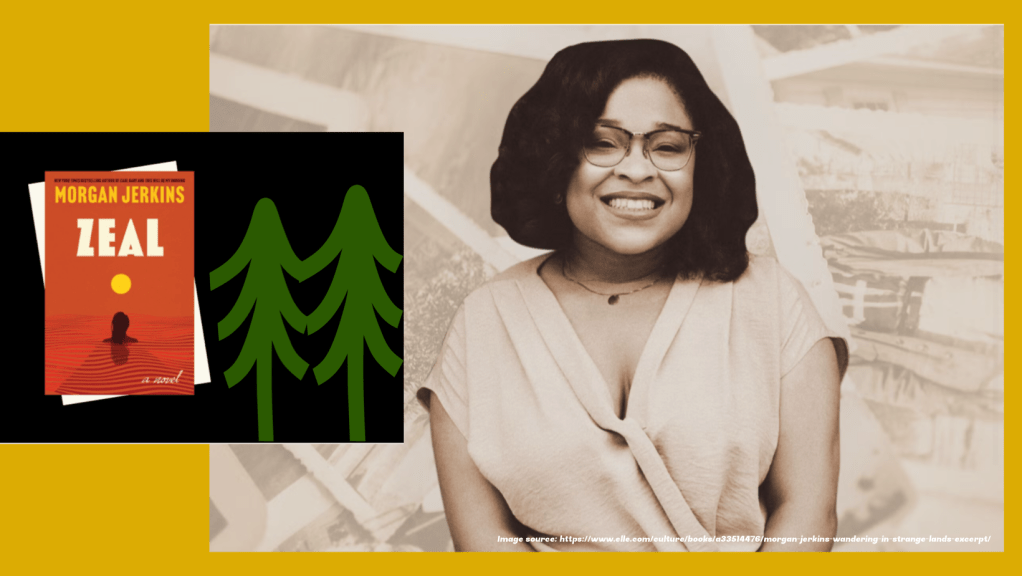
Zeal /zēl/ – powerful fervor in/whilst aiming to achieve (a mostly common) goal. Jerkins writes as if she’s stood in the historical bowels of Henry Louis Gates’ “Finding Your Roots”; had a conversation with the roaming ancestors guarding precious truths. Zeal is a call and response between the choir and congregation – the elders spread amongst all pews, resting peacefully with their eyes closed, bodies gently moving in sync with the rhythm of the psalm; souls open yet protected. So protected. Zeal is the love story we didn’t know we needed. It tells of love’s ability to stand the test of time and time’s ability to shore up love. Jerkins takes the reader back; way back. Then brings them forth. And we ponder on whether time only moves in one direction.
Jerkins ushers the reader through summer 1865 Mississippi to Great-Migration era Kansas to 2019-2020 Harlem. Harrison and Tirzah are the two sturdy trunks of trees whose branches hold conversation just at their roots. They are a side-by-side survival of the fittest that share ground. It is Tirzah’s letter that opens the storyline of the novel as a modern-day couple (Ardelia and Oliver) celebrate their engagement party with Tirzah’s letter gifted as a pre-marital heirloom. Then, we are transported back to where it all began – Natchez, 1865. Hardly free yet deeply in love, Harrison tries to find Tirzah after being discharged from the Union Army following the war. It is this split, it’s surrounding climate, and its resulting air of yearn, disappointment and push-through that frame the 416 pages of Zeal.
Nuclear. Jerkins explores many classic American institutions through her development of the family structure in this novel. The obvious goal of each union is to be free enough to be with the one you desire. However, in said attempts to come together, both survival and the churning underbelly of duty/circumstance create an almost perfect storm. And after the storm, all parties are turned to and fro, too tired to fight for what they truly want. Harrison, exhausted and illiterate, resigns to building a family unit with Tabithah – the very woman who foils his efforts to find Tirzah. A nuclear family is indeed formed as Harrison and Tabithah form a union and even offspring (a daughter named Miriam). However it is sure to explode-up the lies, betrayal, forced ignorance and even seediness surrounding family ties as they relate to slavery, war and lineage. The resentment is evident and so is the fervor of survival.
Separation of church and state. When I think of Tirzah’s character, I think of the book title: A Woman is a School. And I can remember a time where prayer was allowed in school, and lunch-dates with the littles was second nature. But I also remember the stories of black women’s bodies being used as science projects – studied for both mere sport as well as the hope to improve the lives of those deemed worthy. One might even say that Tirzah is sacrificed – her idea of freedom tainted by those claiming to love her the most. Like Harrison, Tirzah laments to a life with the good option: a minister named Isaac. Outside of Tirzah’s sacrifice, there are other sacrifices that take place for this union; such as the helpful Quaker, Tirzah and Isaac’s son Free, and even Isaac himself. Tirzah is witnessed by her future daughter-in-law committing the ultimate lay crime (forgive my cheeky oxymoron; as every sin is equal…right?) and thus falls into a sort of trap set by the very system she and her loved ones are trying to survive in. She must run…again. Though the shackles of the state are shaken off, the shackles of the church still grip tight and we ponder: perhaps this separation (of church and state) was a mere facade in the desert.
Only Children. Miriam (female with a melancholic whimsicality) is the only child of Harrison and Tabithah. Free (male and painfully gifted) is the only child of Tirzah and Isaac. Miraculously, following huge upheavals in both of their lives, they meet and form a sort of otherworldly bond. Jerkins does a phenomenal job at relaying the complexities of this…meeting of the two offspring of survival and zeal. The weight is palpable – Miriam carrying the orphaned outturns of both paternal and maternal heartbreak, and Free hoisting the murdered fallacy of a required new last name. They are both drawn to each other and repelled at the same time – attracted like romantic partners, working out kinks like siblings. The creation and development of their characters is pretty brilliant on Jerkins’ part and woefully depicted that chasm many of us must approach, avoid until we can’t, and thrive through (however yucky). Moreover, Miriam and Free pull at more than the reader’s heartstrings, but yank also at one’s rearview and sense of justice as only children can (do NOT pardon that pun).
“I loved a flower so much that instead of plucking it, I left it alone.” -Osho
Not Through With Me Yet. As Jerkins depicts the many branches of these two adjacent tree trunks, the reader is able to both walk the valleys and delight in the journey that both Harrison and Tirzah commence. The reader witnesses country life turn to city life as these lineages migrate in the direction of black freedom – to and through Kansas, Chicago and New York. Necessity turns into artforms and sustenance, even livelihood as the families grow and encounter seeds that bloom and seeds that indicate where the bad soil was/is. Regardless the soil, these lineages are compatible with life! And through Ardelia and Oliver, much is uncovered yet much is still unwritten. In a world such as the one in which we live (not so different than the worlds that came before), I imagine that one might tell the one they love, “If you are safe, stay where you are. Get here (only) if you can.” It is a conundrum’s tale…as old as time. And Jerkins does a fantastic job at showcasing a historical, multi-generational fiction. Zeal is a little baby of color who has been here before.
Work Cited:
Jerkins, Morgan. (2025). Zeal. United States: Harper Collins.
 MAHism2026: prose, poetry, peculiarities...