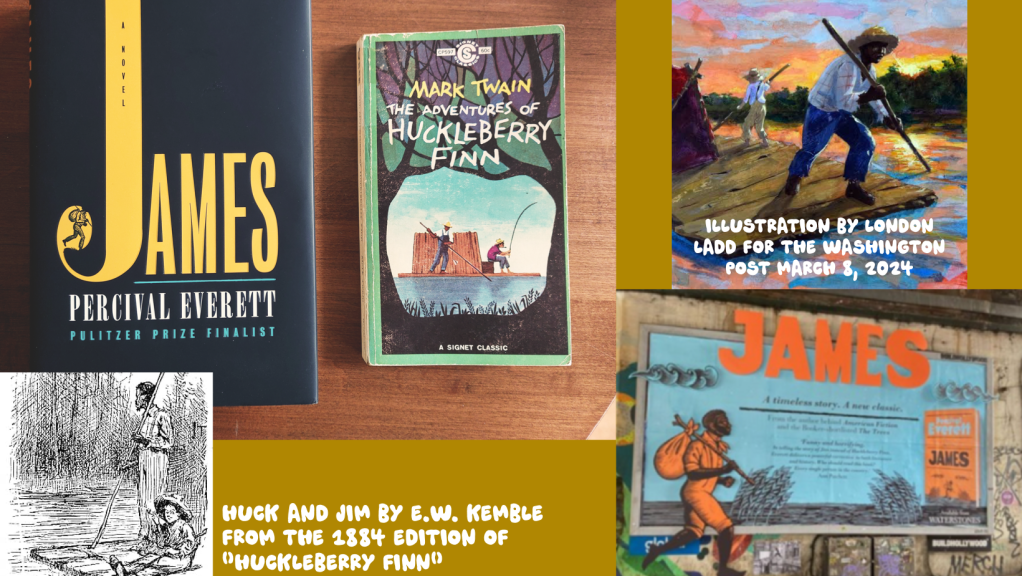
–In the Beginning– This will likely be more than a book review, as this book is more than a book. It’s a love letter of sorts, perhaps even a postcard sent from abroad, a Polaroid snapshot of a renamed landscape encompassing both past and future. Everett deserves all of the accolades garnered. Let me start by saying that I have never met a James I did not like. James – Hebrew and Latin in origin, meaning may God protect. Rarely a name placed in the middle, it fares well as a first or last. And this is interesting. Though there is indeed power in a name, the way one yields said power is the real essence of their being. Everett does not frame his main character as a simple hero. But instead as a teacher. Perhaps reluctant at times and even with an air of tongue-in- cheek, James (Jim) is a protagonist that teaches whilst surviving. He seems to be shielded by a force unseen as the adventure framework of Huckleberry and Tom (children, male and white) are nightmares manifest to James (adult, male, and black). Everett makes the reader want to know of this otherworldly force unseen that seems to walk, run, swim, and even rest with James. I watched the The Book of Eli while reading James. I’m learning to not be so spooked when synchronicities cuddle up in my lap. The watching and the reading of these two works of art was just that – a wading synchronicity highlighting the importance of language, literature, literacy. Toni Morrison proclaimed, “…we do language. That is how civilizations heal”. There’s much healing to be had in pre and post war, apocalypse, growing up (not to be confused with simply aging). Language gauges the degree of separation. Finally, we realize we are and have been shoulder-to-shoulder. The separation, a mere facade in the desert, and a white lie on the plantation – salt water to the thirsty, and a pine box to the finally free.
–The Word– The novel is set in Hannibal, Missouri – a necessary nod to Mark Twain’s original novel. I would urge the reader to research the term Hannibal past the knee-jerk allusion to the psychopathic doctor namesake (although, that may be relevant as well); and also accept the phonetic similarity of the state name and term Missouri & misery respectively (as this is also relevant in my opinion). Jim is self-taught and duplicitous in his use of language. The word – his safe place, a hiding space or stage depending on the situation. He is careful of his use of proper vernacular not only because it could reveal his learned state and thus position him as a threat to his oppressors, but also because his movement throughout the world (whatever and whichever world) depends on it. James utilizes ‘slave talk’ when needed but teaches, dreams and narrates in proper English where secure and applicable. The point is: in a world banking on him not knowing, he does indeed know. He is faced with being sold away from his wife Sadie and daughter Lizzie to another plantation down in New Orleans. Upon deciding to run, James is followed by Huck who has faked his own death in an effort to escape his father. The two hide out across the river on Jackson Island and thus begin the adventures of Jim and Huck? The search for Jim and Huck? The trials of Jim and Huck? The story of James. Everett is adamant in relaying the dualities that reside in James as well as his tricky positioning. His only possessions are not even the clothes on his back; they are a waterlogged notebook and a pencil gifted in blood. His station in society is runaway slave although he has a wife and daughter. His main companion on his journey away from and back to the plantation is a little white fella who he just can’t seem to shake. Thus, Everett makes a clear point – one’s simple may be another’s very complex. Moreover, Everett’s depiction of Huck’s refusal to be excluded from the story of James is a word within itself.
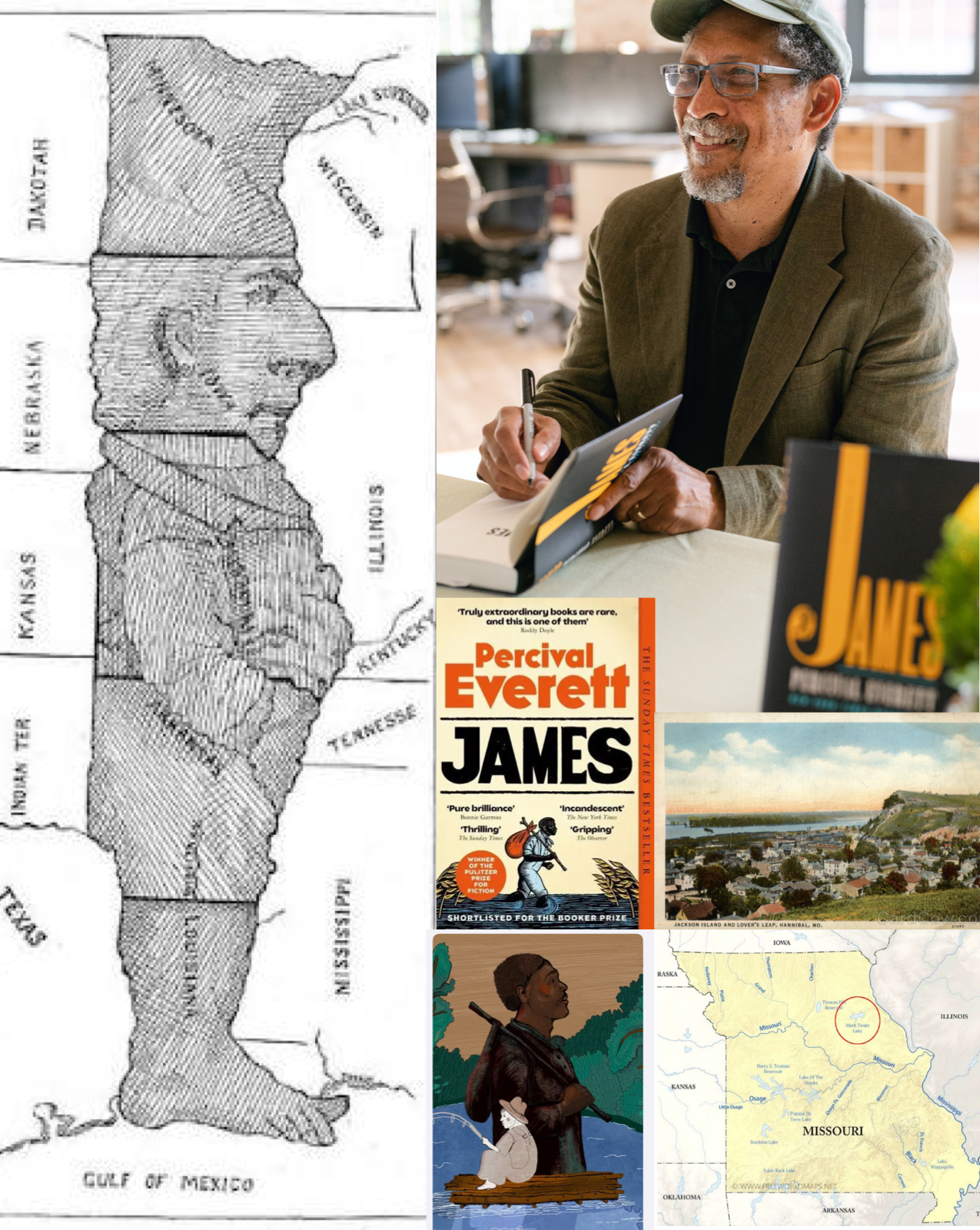
–The Belly– Jim and Huck are separated on multiple occasions; their separations preceded by multiple strikes…of steamboat, of ally, of human sale, and of truth. I think when one strikes the truth it makes a sound. Like a massive tree toppling into a large body of water or like a ship splitting in two, like a paddle striking flesh. Everett makes a point with the splitting of wood and splashing of water as these two are desirable yet problematic; much like lumber for burning and Adam’s ale for sale. The complexities of coupling necessity with exploitation is loud and evident. This system of slavery has touched every character in this story and left behind a smoldering
destruction. Everett does not allow for debate in this area (rightfully so). Each introduction of a new character or character group places Jim and/or Huck in a sort of love below situation – just above the reproductive parts but below the heart and mind. Each separation of the two leading them to inevitably find each other again as they run into polarities that will either yield rebirth or regurgitation. Everett is clever in his depiction of the duo’s interactions with others. This humanistic need to form alliance, friendship, family – is it a welcoming invite of pure intention or a methodical crash?.
“…just because someone desires you, it does not mean that they value you. Desire is the kind of thing that eats you and leaves you starving.” -Nayirrah Waheed
–The Beast– Indeed, there are many meetings of mind, heart and soul in James. The four black men hovering over an awakened Jim signals his arrival to Illinois and the horrific value (or cost) of a writing utensil. Huck returning with two criminals relays the extraordinary utility of self-proclamation and the ridiculousness of playing church. The introduction to Easter (an elderly slave and keeper of a livery) informs the reader that even sleeping unshackled comes with consequences. James’ singing voice summons The Virginia Minstrels and a surface agreement is made – common decency in exchange for black face and a fondling of the mind’s area without consent. Our introduction to Master Henderson expands upon this lack of consent as Henderson runs a brutal sawmill and has been raping little Sammy since she was pre-menstrual (again, I urge the reader to explore the phonetic kinship of menstrual & minstrel). Sammy runs with Jim and is eventually a casualty of stripped femininity, stripped lineage, stripped safety, stripped language. Working with wood from sun up to sun down and finally meeting her end as she is shot while attempting to escape across a body of water; she is a casualty of slavery. Jim and Norman’s arrival onto a riverboat reveals the machine’s crazed engine – a slave named Brock in charge of feeding coal to the boiler and making the boat…go. Through Jim and Norman’s interactions with Brock, Everett makes a finite point – the system is unsustainable; no one thing (coal), person (hydro-power), place (wood) can satisfy this beast.
“One must say yes to life and embrace it wherever it is found — and it is found in terrible places; nevertheless, there it is.” -James Baldwin
– The Beauty– Jim and Huck are jolted back together following the explosion and sinking of the riverboat. James’ desire is made clear – he wishes to be reunited with his wife and daughter. However, the means of acquiring them has also been made clear – unsustainable, treacherous, a feeding of an insatiable beast. The duo return to Hannibal and in Jim’s old cabin they do not find Sadie or Lizzie, but rather a new slave couple by the names of Cotton (go figure) and Katie. It is as though they’ve returned to a scene from Jordan Peele’s Get Out. But though the scene is the same, neither Jim nor Huck are. They have gained a new knowledge about how the world works, how Hannibal Lecters are born of a naughty child’s Christmas gift, how blindness can be both a gift and a weapon, how passing doesn’t keep one from passing away, how mention of a breeding house can drive a man mad or crash him into sanity. We can see the dots, the zeros and the ones and we know (almost immediately) that Shonda Rhimes did an excellent job at depicting a grown-child Huck and a hair-touched Olivia Pope. Jim can no longer offer Huck the gift of blindness and so he offers him possibly the next best thing(s) – the gifts of truth and choice. As Everett informs the reader of the impending Civil War, Huck is now armed with the truth of paternity coupled with the truth of societal workings. Jim learns through Sammy and Katie that 🎵 nothing even matters 🎶 past the realization that the vulnerable portals of life can be sold, maltreated, and bred. This system does weird, nasty things with the ideals of consent, rights and wrongs. In 2025 it seems like a far-off concept, something in the past too terrible to see the light of day. In 2025, Everett is telling the reader to get their head out of their asses; the oldest professions (prostitution, scamming/thieving, lay preaching and soldiering) prove staying power if nothing else. And, Civil War is already amongst us. Who else would they put to work and to war if not the descendants of wood and water?
–The Rest– James lays to rest the ideology of ‘doing good for goodness sake’ and awakens the notion of ‘faith without works is dead’. Both the overseer Hopkins and Judge Thatcher receive lessons before their penalties are enacted out by Jim’s hands and faculty. Jim makes it to the Graham breeding farm and sets the surrounding cornfield ablaze ultimately leading to the farm owner’s own penalty and the freeing of the slaves. Iowa is the landing spot for James, Sadie, Lizzie and a few other escapees. When asked of his nomenclature, James offers up yet another lesson that Everett leaves open-ended. Here’s my take: whether you are walking with the King James version of yourself or standing up in the first-name only, every version of you deserves to know you are there. And the novel seems to fall into a sort of calm resting place…on a bed of structured (yet creaking) wood cradled by a churning (yet steady) water. Percival Everett did a thing with the novel James. A Go(o)d thing.
Work(s) Cited:
Baldwin, James. (1963). The Fire Next Time. United States: Dial Press.
Everett, Percival. (2024). James. United States: Doubleday Publishing.
Waheed, Nayirrah. (2013). “The Color of Low Self Esteem”. Salt. CreateSpace Independent Publishing Platform.
 MAHism2026: prose, poetry, peculiarities...