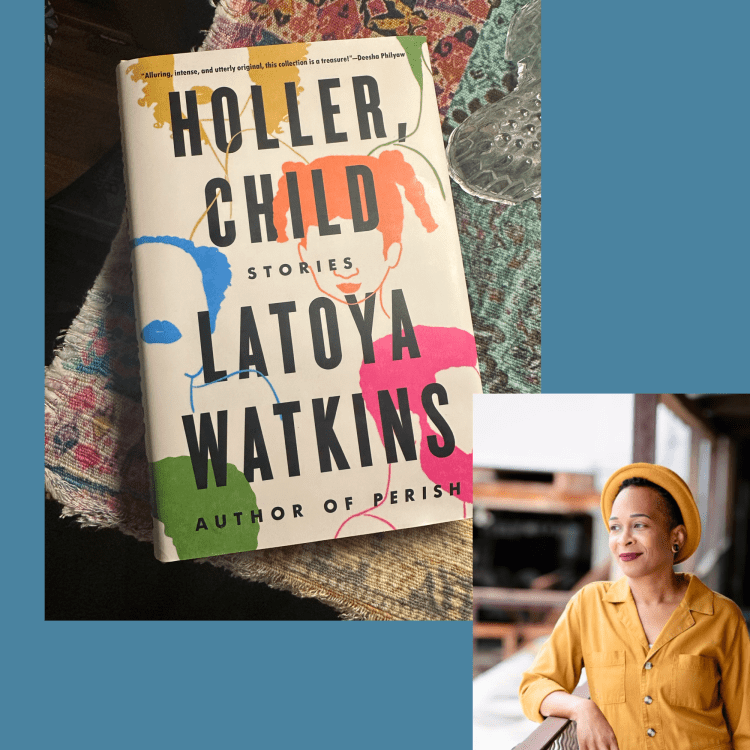
There are eleven heart-moving stories placed into this collection by Texas author LaToya Watkins. Each story is tossed at the reader in an endearing manner; a manner that sets the reader up to succeed – to catch, to understand and to answer back truthfully with their own mental and emotional grasp and release. There are recipes beyond the eleven windows we gaze through in Holler, Child. Recipes that have been lost, and found again. But first, there is the pain that must be drudged through – the questions that linger on the window seal like sharp shards of glass. How did the stovetop get so dusty? When did the inhabitants decide that these walls were suffocating? Why would grandmother store the recipes in the bedroom instead of the kitchen? What did she mean by…a pinch of nutmeg? Watkins’ stories are a pinch of this and a pinch of that; made successful by the atmosphere(s) of home and the pursuit of love and somebody (or some thing) knowingly or unknowingly helping you decipher a recipe written by hand on oxidized paper in ancestral dialect. Sure, we might holler in joyful glee when we get the recipe right. But, we can holler too, when we need some help.
The Mother – The first of the stories is of mother and only son. We journey through beckoned (even reluctant) storytelling as the glass gets thin enough to shatter. And we see that stories are not just what we make them but also for whom they are made. Watkins traverses the story of an only son’s coming to be and how he is to be remembered once gone. There are a number of characters who make it through the mother’s threshold soliciting the narrative of the only son, but the one that elicits validation (true or otherwise) is the only one left who can return the sentiment.
Time After – The eleventh and last story in Watkins’ collection is titled without fault and moves like a song. Alluding softly to the collection’s first story, we are again in search of an only son – his story and its edits; the oracles being the women in his life sharing a good part of his genealogy, childhood and rearing. Time After seems to function as a purposeful conclusion to this collection with the ever-present theme of understanding scaffolding the tales. It pulls at the parts of you that deeply ask why, wishes things could be different, hopes to make a fool out of both patterns and time. But because no one has ever really truly been successful at making a fool out of time, we lament to being present for those we truly love (time after time).
This is a necessary collection of short stories with timeless depth and span. Stories two through ten are the guts and the oozing filling in the dermis that are stories one and eleven. Watkins brings her characters to life during both the pinnacles and valleys of their evolution. Each story has a holler mechanism – the jubilation at the end of the search, the tribulations surrounding the time in-between, the peeling back of scar tissue to reveal the real wound. The recipes function as both the tracing backwards and the leaning forward. Like a string of museum exhibits – all eleven lined up in a row; a separation of thick glass between the exhibit (the story) and the voyeur (the reader, sans ick). We look through the glass window of each exhibit while Watkins guides us through the joy, the journey and the pain. Though we may not be left with a cake, or pie or even bread, we are indeed left with a homemade holler heard through the thickest windowpains.
Work Cited: Watkins, LaToya. (2024). Holler, Child. Tiny Reparations Books.
 MAHism2026: prose, poetry, peculiarities...