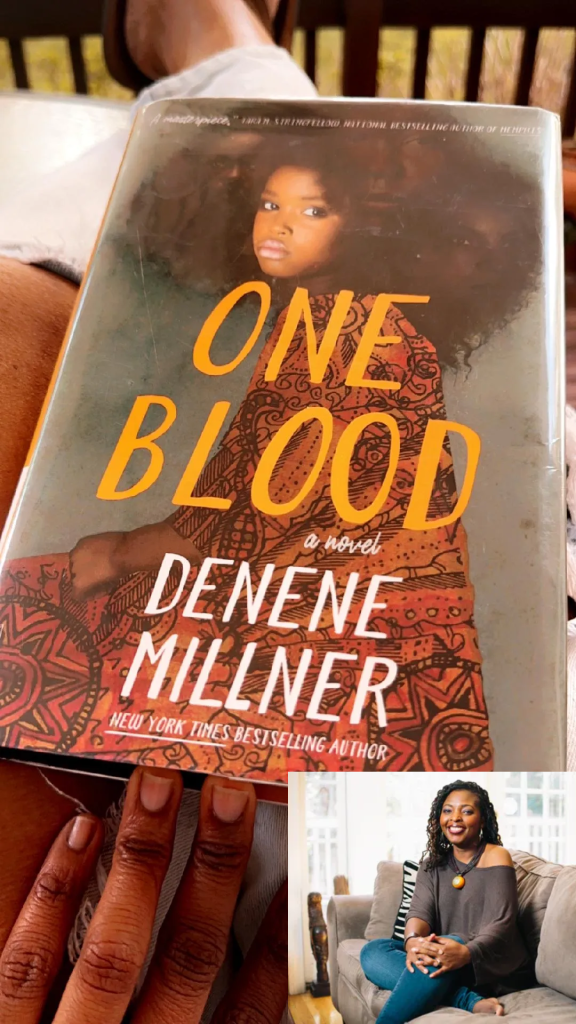
Our grandmothers proclaimed that giving birth was closest a woman got to dying without actually…dying. Denene Millner’s ‘One Blood’ reinforces this notion. From preteen to post heart-attack there’s much resurrection in her words. It is a book that hit close to home as I am a Maternity Nurse by trade. Scent. Scent of earth and fresh rain comes to mind when I think of blood. I was never repulsed by it. Trust me, there are so many other things to be repulsed by. Blood is controlled mostly by the pumping of the heart. For women, the heart lends its control over to reproductive organs every once in a while and they (the heart and reproductive organs) do a little dance. I’ve always admired the cardiac care team. The heart is tricky, beats to its own drum, has its own rhythm. If cardiac nurses and doctors were artists, they’d surely be musicians. The women’s care team – painters, and of course writers. This book is part of the women’s care team and may one day be required reading for anyone looking to enter into that…this field of work. If ever one really wants to learn the ins and outs of the community in which they reside (or travel through), do some birthing work. Where are the babies born? How are the women treated?
What does family and communal support look like? What are the treatment modalities? What’s an acceptable child-bearing age? There’s a veil that is lifted in ‘One Blood’ and behind the curtain we see the walls painted in different shades of red. Though the powers-that-be try with all their might to force the painter’s hand, the heart never gives up its authentic faculty. Thus, we begin with Grace.
The three sections of Millner’s book each feature a female character that wraps her story around our waists. Grace is the focus of the first section – a preteen who is eager to learn and knows both safety and ingenuity rest in her grandmother’s hands. Those hands hold so much of the surrounding community with a careful pull and tug. Grace’s grandmother is an essential midwife outside of the barren walls of hospital rooms turned birthing suites. She knows the color of soil is the color of old blood. Grace and her grandmother share this color. But, Grace must learn that there is pushback to this pull and tug. There is appreciation in the blood but there is also resentment. And so we ebb and we flow. Millner introduces the upscaling of birth certificates as what’s red and liquid has the man-made need to become black and white, recorded, readable and even punishable by law. It is this introduction of paper inked in red that finally highlights the truth (in black and white) – one is permitted to share their gifts until their gifts don’t align with the yellow lines headed toward the status quo. Grace’s story is complex and wrought with both intense love and intense loss. It makes the reader question our basic desire for what is good, what is better, and what is best. We follow her as her journey begins in South Carolina under the tutelage of her Grandmother’s birthing hands and continues in the North with her own hands catching her own baby. Sleep consumes her after such a tiresome journey and she awakens, still bleeding, the afterbirth likely still warm, with her hands empty. Her story is gut-wrenching, bidding a nod to social upheaval, the injustices that result from those clamoring to reach a wobbly pinnacle, and the innocence that is drug behind upward mobility. So, though we begin with Grace (and though her gift to the world within this book is deep, vast and wide), the journey will likely take us low.
Deloris is the main character of the second section of ‘One Blood’. She’s introduced as spunky, fashion-forward, and with too much life lived before her adult years. Folks refer to her as LoLo and within her world we see clearly who gives, who catches, who takes and who keeps. She’s expected from school-age to give as a mother would, as a wife would, as a big sister should. There are dangers in placing too much weight on bones that are just shy of cartilage. Further dangers lay around and about the taking…so much taking. A wall of secrecy is what guards LoLo even within her marriage. Yet, it is (adoptive) motherhood that finally peers beyond this wall and dismembers it in a way that’s as benevolent as humanly possible. Millner portrays both the hurt and healing that lies within this trickle of hematic lineage. Even if/when it (true blood) trails off course (willingly or unwillingly), gets placed in a dark basement, is hidden just beyond a southern dirt road, it can do good. LoLo’s story asks: who came to get you when you were hiding from yourself? And: how dim did it have to get before you realized you (and they) could see in the dark? Also: Why was it a familiar woman? She devotes herself to her husband and her kids, never being taught self-care or even self-knowledge. Her body and mind-frame are hammered, tucked and slid into the shape of a stage for everyone else to walk across. She is low so that they may be high. Major damage is done…but great is the rectification walking these characters from low and dark to solid ground during daylight.

The final section is the Book of Rae. Rae teeter-totters between the desires she knows not of having and the desires that have been handed down to her. We’ve all done it; looked up one day and thought… who’s curtains are these shielding me from the sun? They are surely not what I would’ve chosen to decorate my windows. Still, we have yet to reach an answer when one asks what curtains we actually want, if any at all. Thus, we utilize the ones that are already hanging. She is walking on a balance beam placed before her – to swim or not to swim (hair), to read or not to read (knowledge), to marry or not to marry (connection), to breastfeed or not to breastfeed (giving). She wobbles along until faced with the dismount and it is then she realizes the aching. She cannot help the origin of her roots no more than the sky that feeds them or the soil that cradles them. But, they help her. Rae’s story exposes the wounds of expectation (subtle familial and societal bullying), figurative and literal forced abortion, secrecy, medicinal modalities, and control – all under the framework of motherhood.
Millner writes in a way that leaves the stories open. Open to interpretation, open to dreams, open even to nightmares. Her characters are complex and imperfect. They are not placed on a pedestal; instead, they are seated next to the reader. We see their rich skin, full lips, soft hair. We see also their pain and their process. Motherhood is all-encompassing work. It is as messy as the birthing floor but somehow still unsullied. Even when we are imperfect, this woman’s work of lineage shows perfection; gives back what was taken, proves man-made…lacking, reminds us of the importance of caring for the hands that hold up homemade. Grace, LoLo and Rae tell a tale of mitochondrial blessing, a tale as old as time and as true as blood – we are one, we are love. We are FULL of grace.
Citation:
Millner, Denene. (2023). One Blood. United States: Tom Doherty Associates / Tor Publishing Group.
 MAHism2026: prose, poetry, peculiarities...